AEC Summit 2026: What Gets Funded, Built and Used
Originally published on LinkedIn on 20 October 2026.
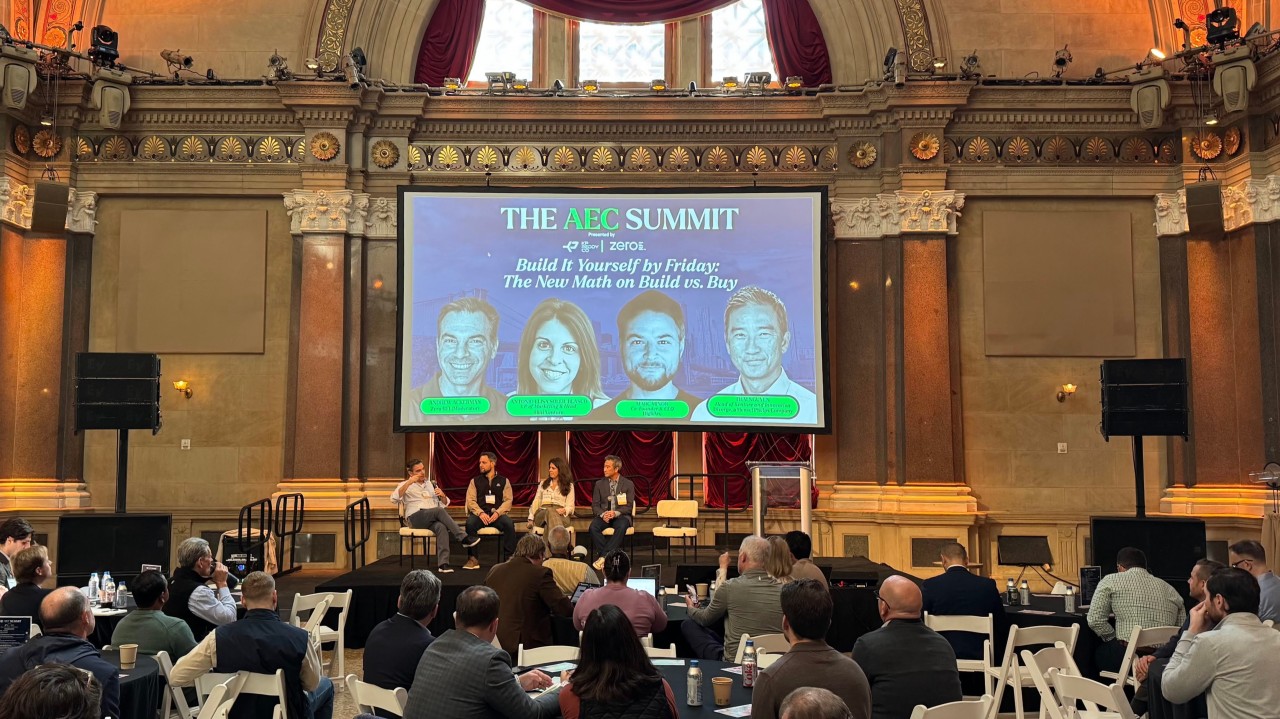
Field Report #TooBusyToAttend: AEC Summit, Brooklyn, 19 October 2026
AI needs power. A robot needs a task it can perform reliably. A new tool needs a company with the time and reason to adopt it.
At AEC Summit in Brooklyn, those conversations happened in the same room.
The brief:
- Project feasibility: capital, power, equipment and skilled people shape what can get built.
- Technology in use: firms are building useful software themselves, while adoption and maintenance remain substantial work.
- People and places: robotics, materials and AI raise questions about human performance, professional judgment and what a building enables.
The programme was dense. What struck me was how well the room held its attention: session followed session, and much of the audience stayed through the end.
People financing, designing, building and operating places described different opportunities, with different conditions for making them work. Listening to those differences was the value of being there.
1. The investment story reaches the construction site
Sam Chandan of NYU Stern put technology inside an economic picture: the cost of capital, energy, uncertainty and the concentration of investment around AI. He distinguished demand for the technology from the returns investors expect. Strong demand can coexist with investments that disappoint.
For AEC firms, AI also means physical work: data centres, power generation and supporting infrastructure. The re-industrialisation panel brought together Robert Ioanna of Syska Hennessy Group, Tom Stringer and Alex Girau of Group1, with KP Reddy moderating.
The discussion brought demand down to practical feasibility. Which electrical system is available? Can the project get its generators? Will the promised power be there? Engineers are being drawn into those decisions earlier. Manufacturing projects also need a workforce that has to be found, recruited and trained.
The battery discussion supplied a sharp example: data-centre demand in which delivery times and supply-chain availability took priority over cost or performance.
My takeaway: technical and procurement knowledge belong near the beginning of the business decision. Demand and funding still need equipment, energy and people to become a project.
2. A useful machine changes a particular job
Micah Springut's presentation on Monumental Labs made the possibilities tangible: robots carving stone, with artisans still part of the process. His proposition concerns what becomes feasible to design and build when fabrication economics change.
The job-site panel featured Nadav Shuruk of Okibo and Tiffany Yeh of Eztia. The discussion moved from the novelty of seeing robots on site towards production rates, measurable performance and the limits of a machine's role inside a larger task. Preparation and complementary work still matter.
A question worth keeping: Sam Chandan saw promise in robots navigating the world as it already exists. The job-site discussion raised a different question: does a humanoid form make sense for work at height? For me, a robot's shape has to earn its place in the task.
In her introduction, Tiffany Yeh presented passive cooling materials worn by people working in heat. The broader discussion also kept human performance in view: helping people stay physically capable and mentally sharp through the day.
For me, that widened the picture of site innovation. New materials, specialised machines and skilled people each have a place, depending on the conditions of the work.
3. Firms are becoming builders of their own software
Robert Entin of Vornado Realty Trust described an internal application for exploring buildings, tenant spaces and lease options, with access to the underlying documents. He also described working with occupancy information.
Carrie Denning Jackson, founder of Place as Medicine and an adviser to Jamestown, explained how external market data became easier for asset managers to use. Dashboards had struggled to find users; bringing the information into a conversational interface made it more accessible.
Earlier, Shannon Brown had asked the room who had championed, sold or bought technology for a pilot, then who had seen it become their company's way of working. The second question set a demanding standard.
The build-versus-buy panel, moderated by Andrew Ackerman, brought together Thai Nguyen of Hensel Phelps, Antonia Elisa Soler Blasco of Hilti Venture and Marc Minor of Higharc.
The discussion showed the work behind that transition:
- Organising internally created agents and tools, including duplication and limited use.
- Implementation and customer success, supported by people who understand construction.
- The distance between a promising internal demonstration and a dependable product, illustrated by an AI rendering system that remained difficult to maintain after release. Narrow, specific tools also came up as circumstances where building for yourself can make sense.
Firms have more ways to solve a problem themselves. Vendors have to explain the continuing value of their expertise, support and product.
Earlier, the scaling panel moderated by Shannon Brown, with Lisa Kelly of Radical Results, Nora Swanson, Ravi Bhatia and Pierce Reynoldson, had raised a memorable constraint: an ERP system can compete with a drywall robot for the same company's implementation capacity.
A tool can be quick to build and expensive to adopt.
4. Experience has to survive the handover
Nora Swanson of JB&B, a Trinity Consultants team, discussed tools shaped around her firm's work, including AI solutions built into Revit, project checking and connected workflows. She emphasised the context of the firm, its users and its clients.
In Soon Mee Kim's panel, Nigel Coelho of Lumber described experienced employees who know the exceptions in a contractor's processes, and the challenge of retaining that understanding as they approach retirement.
In the same panel, Bo Young Lee asked whose knowledge and experience are represented in the systems being built. A later exchange raised a demanding condition for human oversight: the reviewer needs the ability and willingness to challenge a convincing result.
In the re-industrialisation session, Robert Ioanna raised a related concern: faster tools can remove work through which younger engineers used to learn. Increased output can leave a firm with a harder training problem.
The business question: how does a firm preserve its judgment and develop the next generation able to exercise it? Capturing an experienced person's answer and helping someone understand when it applies are both part of the work.
5. Value depends on who receives the result
KP Reddy opened with the fragmentation of a building project: specialist companies working on parts of a whole. A decision in one part changes the work of people elsewhere.
Barry Clark of Zero RFI approached this through communication. AI can make a document easy to generate while leaving somebody else to read it, interpret it and decide what follows.
The recipient's work belongs in the productivity calculation.
In conversation with Harold Reid, Olympic sprinter and coach Mechelle Lewis Freeman described the precision and trust involved in a relay exchange. I kept that account of one person's performance meeting another's alongside the discussions about project handovers.
Later, Brad Hargreaves asked what a vendor could do to stand out from the stream of pitches the panelists receive. The discussion with Robert Entin of Vornado Realty Trust, Carrie Denning Jackson, an adviser to Jamestown, and Andrew Steiker-Epstein of Charney Companies covered several practical routes:
- A succinct message with quickly understandable value.
- A peer network to turn to when there is a problem to solve.
- A personal introduction, backed by data and measurable results.
One warning from the exchange deserves to stay with vendors: a product can solve a problem adjacent to the one the buyer actually has.
My reading: the buyer needs to recognise the problem, assess the result and understand what adoption will involve. Those are useful tests of how well a technology business understands its customer.
6. A place creates value beyond its construction
Carrie Denning Jackson also discussed her work through Place as Medicine and the relationship between the built environment and health: materials, air and water, walkability, nature and community.
The stadium panel, with moderator Chris Nations, Justin Barton and David Carlock, opened with development around sports venues: extending the relationship with fans and visitors into surrounding places and businesses.
These conversations connected back to KP Reddy's opening reminder that the purpose of a school or hospital reaches beyond the building itself. They widened the questions about markets to serve, partners to work with and outcomes a project should create.
Why the room was worth a day
At the close, KP Reddy explained the summit's timing: ahead of next year's strategy and budgeting, while people could still take an idea home and change their plans.
That captured the programme's value for me. An economic outlook met engineers dealing with equipment and power. The freedom to build software met people responsible for maintaining and adopting it. Robotics met a working site's conditions. Knowledge capture met the question of how expertise develops.
The accounts included progress, limitations and unfinished work. Hearing them together gave each more context.
Thank you to KP Reddy, Zero RFI, KP Reddy Co., the organising team, moderators and speakers for bringing those perspectives into one room.
If you were there: which conversation is most likely to change something you do next?

Fractional CTO & Product Delivery · Switzerland
Turning an internal tool or prototype into a product your firm can rely on?
I work with founders and engineering teams on the distance between a promising demonstration and a dependable product: architecture, review and release discipline, and the handover that keeps knowledge in the company. Scope and cost are agreed before work begins.